Tuesday, May 3, 2011

This is the "European 4-in-1" pattern. It is most likely the first pattern that I will be using in this project, as it is the one I am most familiar with, and it is one of the most simple ones in existence.

Here is a little background on this pattern, taken from the CGMaille website:
"European 4-1 is probably the most common weave used in maille-dom, due to its simplicity and ease of construction. It's most famous for being the weave used in European knights' armor. European 4-1 can be made using several techniques, such as one-ring-at-a-time (ORAAT), one-open-one-closed (OOOC) and others."

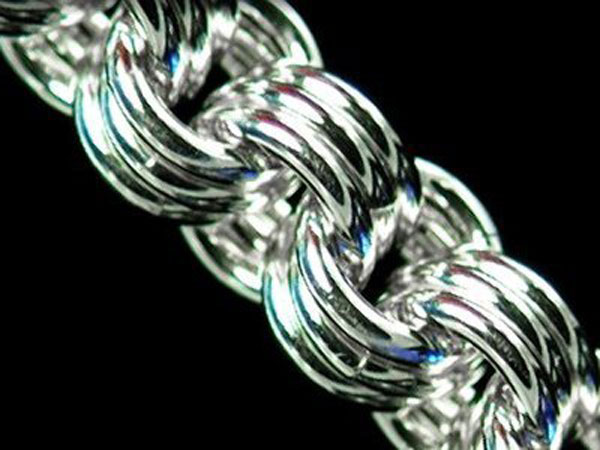
Some examples of chainmaille jewelry:


As you can see, some patterns are far more complex and time-consuming to complete than others. My project will begin with the easiest of patterns and will work through as many of the more complicated ones as possible in the time I have left.

Chainmaille?

So, midway through the class, I'm changing my project. I've decided that I can't learn to play the violin within the allotted timeframe; my work schedule doesn't leave me with enough free time. However, I can expand upon a project I already know something about: designing chainmaille jewelry.

The art of making chainmaille goes back for centuries, and while it was originally used as armour it has of late become used in jewerlry making.The same patterns are used, with lighter-weight jump rings, to create bracelets, necklaces, and rings.

It's a fairly simple project- I will be demonstrating various patterns of increasing difficulty, expressed through the medium of jewelry. I will present them to the class, along with a history of the art and further explanations of the patterns and how they are used.